Natural Highlights: Blue Gray Gnatcatcher


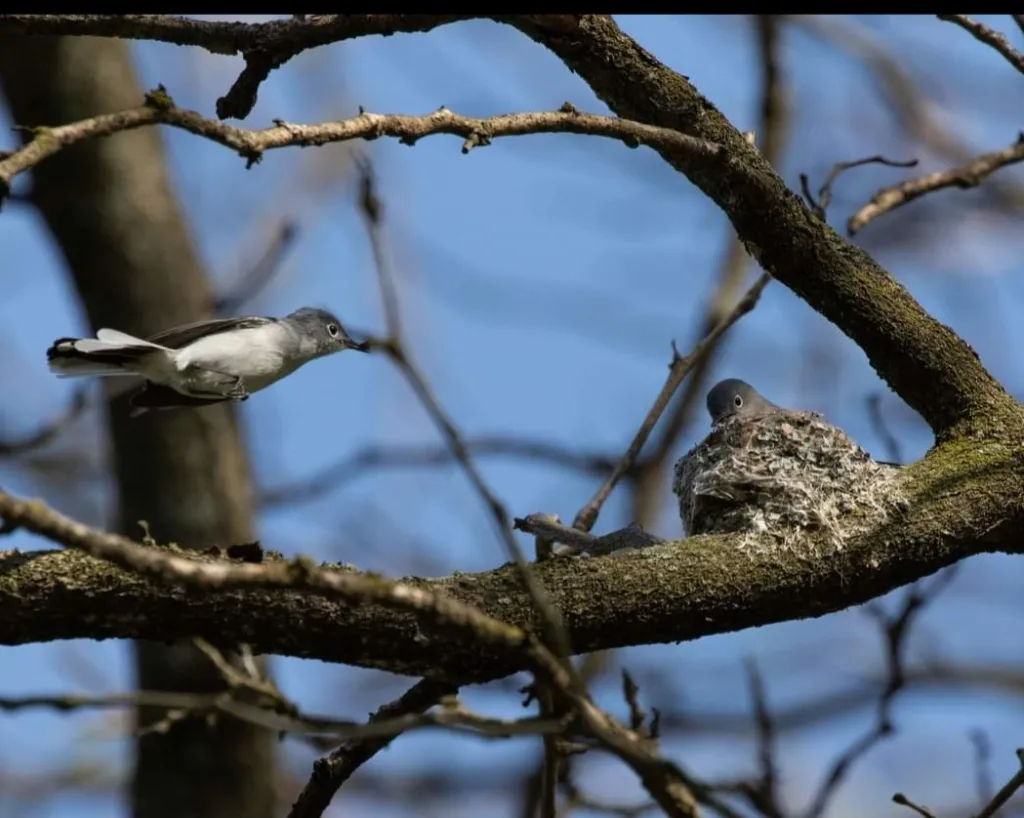
Among wildflowers in bloom, new leaves on the trees, and other delights of April in the Mid South are the avian neotropical migrants, the many bird species returning from Mexico, Central and South America, and the coastal U.S. where they have spent the winter for nesting season. One of these is a tiny sprite of a bird which resembles a miniature Northern Mockingbird: the Blue Gray Gnatcatcher (Polioptila caerulea). Often heard before it is seen, the Blue Gray Gnatcatcher has an insistent buzzy call and song which can be heard along the Wolf River Greenway and any of our woodland trails. It is a very busy little bird, in constant motion, hopping from branch to branch or flitting out to grab flying insects, wagging its long black and white tail, probably to startle insects and spiders into revealing themselves so they can be gobbled up. In spite of its name, the Blue Gray Gnatcatcher doesn’t consume a lot of gnats, though it eats many other kinds of small insects including caterpillars, leafhoppers, flies, small wasps, bugs, and beetles.
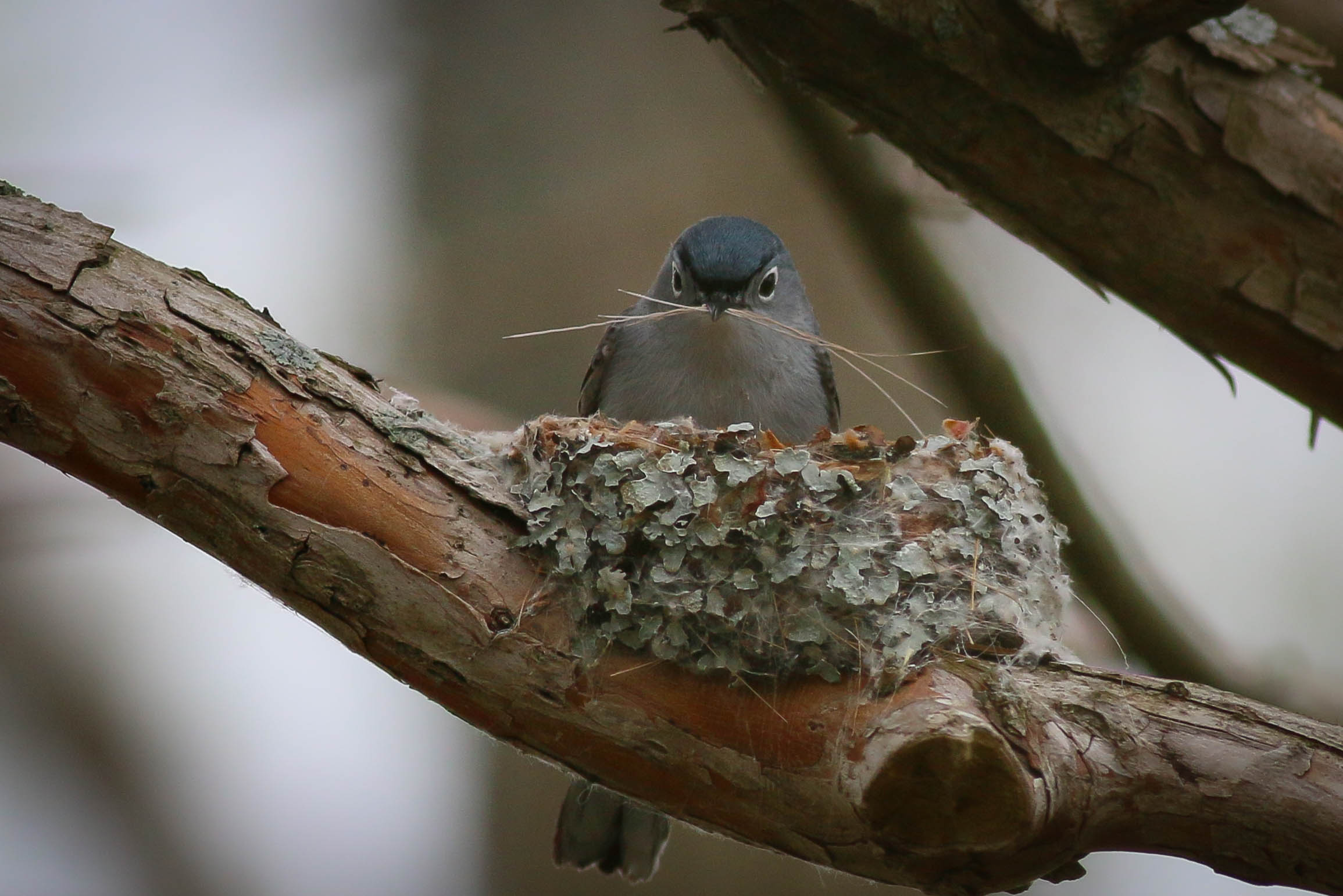
In breeding plumage, the male Blue Gray Gnatcatcher has a bluish gray back and a black unibrow above its eyes, each of which sports a distinct white eye ring. Juveniles and females are simply gray, and all are whitish below with long black and white tails. Both males and females participate in nest building, incubation, and rearing of nestlings, and they usually build more than one nest at a time – sometimes seven or more - the male beginning a second nest as the female adds finishing touches to the first. This is probably to mitigate the loss incurred by many bird and mammal nest predators, and by cowbird parasitism. If a cowbird deposits an egg in their nest, the miniscule Gnatcatchers will work frantically to raise a big cowbird chick, thus depriving their own young of food. Gnatcatcher nests are similar to those of hummingbirds, composed of spider webs and plant fibers and decorated on the exterior with bits of lichen.
The Blue Gray Gnatcatcher is the only member of the Polioptilidae Family in the Mid South. There are three other gnatcatcher species in the western U.S., along with the Blue Gray Gnatcatcher, but the other 18 or so occur only in Mexico, Central, and South America. Fortunately, in part because these birds can utilize a variety of habitats including forest edges and scrublands, their population seems to be holding steady and perhaps even increasing. The “silent spring” forewarned by Rachel Carson in her seminal 1962 book of the same name has not yet come to pass thanks to environmental awareness and action, including the formation of land trusts like the Wolf River Conservancy. And so for the time being, the Blue Gray Gnatcatcher continues to add its fussy little tunes to the eruption of birdsong we can experience outdoors every April.
For more information, please visit these links:
https://www.allaboutbirds.org/guide/Blue-gray_Gnatcatcher/overview
Voice of the Wild Podcast: Blue Gray Gnatcatcher Sound ID (video)
https://georgiawildlife.com/out-my-backdoor-blue-gray-gnatcatcher
April brings Blue Gray Gnatcatchers to the Mid South, tiny migrants with buzzy calls, busy tails, and lichen spun nests.