Natural Highlights: The Yellow Sandshell


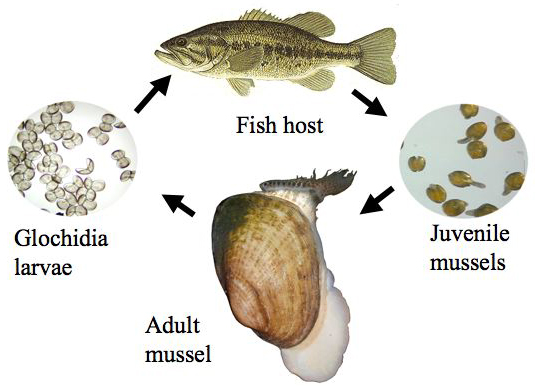
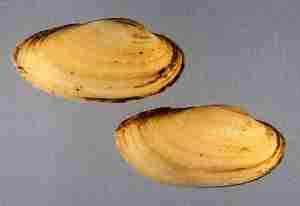
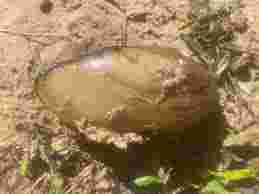
One of the aquatic organisms that will benefit from our habitat restoration efforts during the upcoming World Water Day service project on March 28th is the Yellow Sandshell (Lampsilis teres), a freshwater mussel which is comfortable in turbid rivers with sandy or muddy bottoms like the Wolf and the Mississippi, and can be found even in the urban stretches of the Wolf River where more sensitive mussel species do not occur. Its thick yellow shell helps to protect the adult mussel, which can also burrow into the substrate with its muscular foot. Mussels are able to move around on the bottoms of rivers, but do not tend to move far or often in their lifetimes – which can extend many decades under good conditions. These interesting mollusks depend on fish for reproduction and dispersal, tempting fish to come close enough so that mussel larvae (glochidia) can be released to attach to the fish’s gills or fins. The glochidia will spend several weeks or months on the fish, causing no apparent harm, before dropping off onto the river bottom as a tiny mussel with a shell. How does a female mussel tempt a fish? Often by making her mantle – the soft tissue protruding from the shell – look like a tasty bug or a small fish. As a generalist, the Yellow Sandshell isn’t picky about her fish hosts, using bass, bluegill and other sunfish, gar, crappie, perch, and perhaps other common species.
Tennessee is a state rich with freshwater mussel species, with about 130 species recorded here. Sadly, some are already extinct and about 40 others are endangered. Degradation of rivers and streams is largely to blame, as are the pearl and button industries of years past. Mussels are still harvested today to create seeds for the oyster pearl industry, though harvests are now regulated and mussel populations are monitored.
Like most invertebrates, freshwater mussels are unsung ecological heroes, largely unappreciated as the unique and exquisitely adapted animals that they are. They are humble-looking creatures, after all, not given to eye-catching colors or movement, but they perform vital functions in aquatic systems. As prey, mussels provide food for otters and other mammals, waterfowl, and fish, and their burrowing behavior increases habitat complexity which supports a diversity of macroinvertebrates. Notably, the filter-feeding mussels have an immense impact on water quality; a single mussel can filter about 20 gallons of water daily, removing sediments and some toxins as it feeds on plankton and organic matter. “In fact, one estimate of mussel filtering capacity in the Mississippi River totaled 53 million cubic meters per day. Compare that to a wastewater treatment plant that, for example, might have a capacity of just 0.7 million cubic meters per day” (Xerces Society). But mussels do have their limits; thus, the presence or absence of freshwater mussels serves as an indicator of water quality, with lower species diversity in degraded streams.
Native freshwater mussels like the Yellow Sandshell are part of Tennessee’s rich natural heritage, deserving of our efforts to protect the watersheds which protect the water and the ecosystems they depend on. We look forward to working with all of you on March 28th as we improve a small part of the Wolf River and Mississippi River watersheds for the benefit of all!
For more information on the Yellow Sandshell and other mussels, start with these links:
https://www.tn.gov/twra/wildlife/fish/fresh-water-mussels-in-tennessee.html
https://www.youtube.com/watch?v=OWjlwfx67eY
https://animaldiversity.org/accounts/Lampsilis_teres/
Short video clip of Yellow Sandshell attempting attract a fish host.
Yellow Sandshell Mussel & Wolf River Water Quality