Natural Highlights: White-marked Tussock Moth


National Moth Week, July 18-26, offers an opportunity to celebrate and learn more about an important group of insects which help to support birds, bats, frogs, and many other kinds of wildlife, and to add your observations of iNaturalist. While the colorful butterflies get all the attention, they make up a mere fraction of the Order Lepidoptera which includes both butterflies ( ~20,000 species) and moths (~160,000 species). The reasoning is that moths evolved before butterflies and thus had longer to diversify.
Tussock moths of the Family Erebidae have fuzzy, spectacular, easily recognized caterpillars which become cryptic adults with the muted dusky colors typical of nocturnal moths; they are among the many moth species occurring in the Midsouth. While the adults rely on camouflage to stay hidden from their many predators during the day, the caterpillars are designed to catch the eye and warn predators away, with hair-like tufts of irritating setae of various lengths and colors. Casual observers can see them along bridge and fence rails on the Wolf River Greenway, on the trunks of trees, crawling on the ground, or elsewhere. The bristles on most tussock moths are formed from chitin which can penetrate the skin when touched and cause a rash or allergic reaction – so, as with most insects, hands-off appreciation is best.
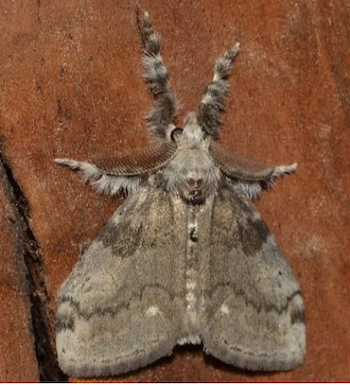
The White-marked Tussock Moth (Orgyia leucostigma) is the most frequently encountered of the four tussock moth species noted in iNaturalist for this area so far. This species has an especially flamboyant black, white, yellow and red caterpillar which feeds on many kinds of trees and shrubs as it grows – oaks, cherries, hackberries, willows and others. Despite its defenses, the caterpillars are still targeted by predators such as birds and wasps, especially when newly hatched and small. After several weeks of feeding on leaves, the caterpillars pupate, spinning fibrous cocoons from silk. After about two weeks, the males hatch out as winged moths and fly away to find a female, while the flightless females emerge with the sole purpose of immediately attracting a mate and laying eggs in a foam-like mass on the cocoon before dying. Neither males nor females have functional mouthparts, surviving only long enough to reproduce. Thus, the lifespan of a White-marked Tussock Moth is only a few weeks long, nearly all of it spent as a juvenile.
There are some simple steps to increase the number of moths you see during National Moth Week. To learn more about moths and “mothing,” we suggest the links below:
https://nationalmothweek.org/mothing-101/
White-marked Tussock Moth life cycle: https://www.youtube.com/watch?v=4pMVOSZnPwI
https://mdc.mo.gov/discover-nature/field-guide/tussock-moths
Celebrate National Moth Week by discovering fascinating tussock moths of the Mid-South and learning how these insects support local wildlife.